
“I didn’t want to do tired tropes”: Sufiyaan Salam on Wimmy Road Boyz
There is something slightly surreal about speaking to Sufiyaan Salam about his debut novel, Wimmy Road Boyz, after spending the last few days with its characters.
They had followed me around, with Safdie-esque tension bubbling under the surface, across the Curry Mile to a shisha bar, through a mini riot and a night of bad decisions, mixed with bravado, sex, grief, and a very questionable version of Wonderwall. By the time I spoke to Sufiyaan, I felt like I knew these boys. Or, more accurately, I knew people like them.
That is perhaps what makes Wimmy Road Boyz so compelling. It’s a book that flits between quick-witted dialogue, from prose to poetry, humour and grief, all packaged within a body of work that speaks to everyone in different ways.
Wimmy Road Boyz, at its core, is about a group of young South Asian men, but it never feels as though they have been created to stand in for an entire community. They are not here to explain themselves. They are messy, funny, selfish, vulnerable, horny, angry and occasionally quite stupid. They are also, in the most painful moments of the novel, completely human.
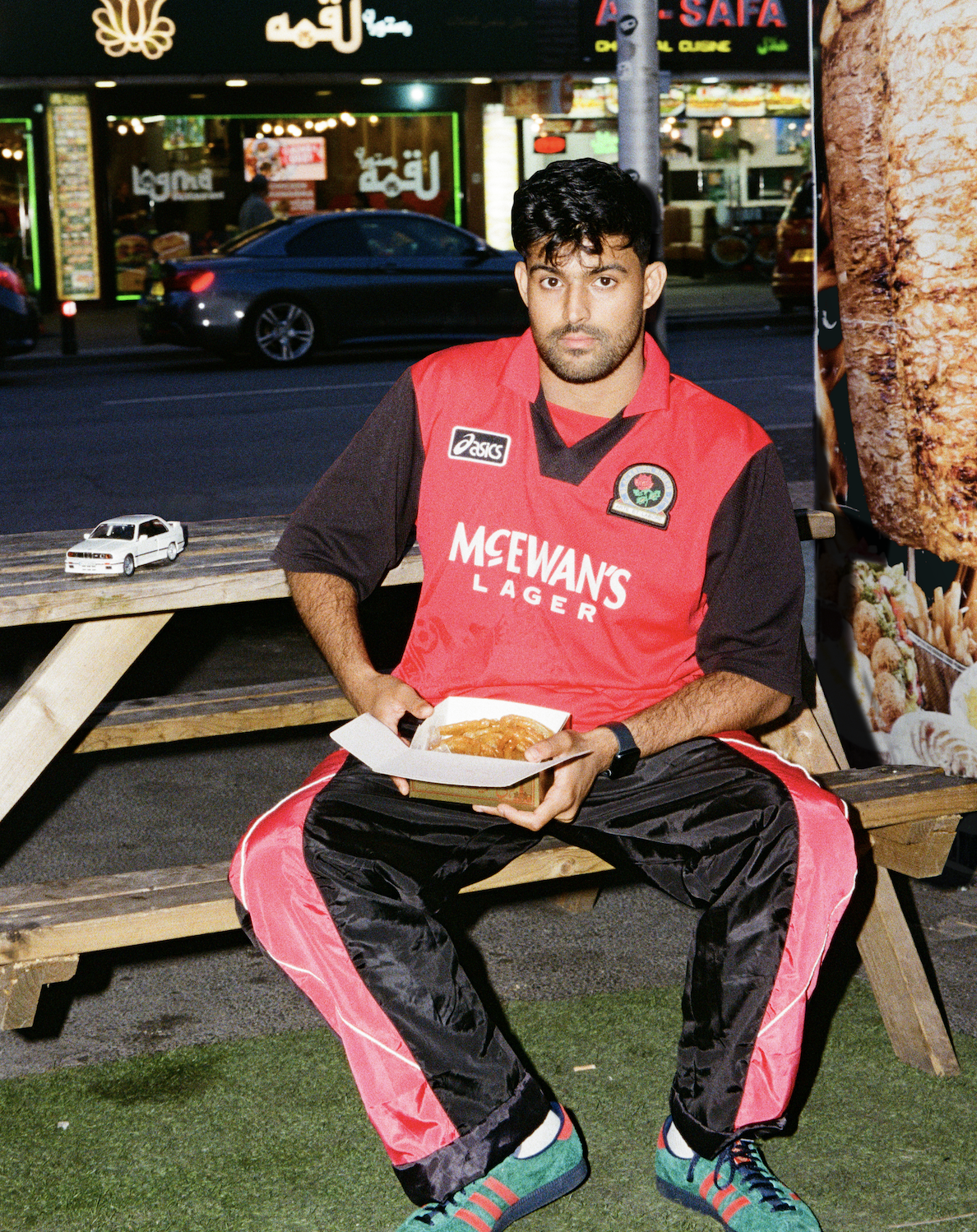
Image: Alina Akbar (@lean0161)
Sufiyaan was born and raised in Blackburn. “It was an interesting place to grow up,” he tells me, “because it's both economically quite deprived, but I think it's quite ambitious. People still dream. It’s just tough.”
Writing, he says, has been part of his life for as long as he can remember. As a child, he made up stories, created films with his friends and sketches on YouTube as a teenager. The professional writing career came later, after years of submitting scripts, plays and short stories, and receiving far more rejections than acceptances.
“I always had this thing of, ‘Nah, but I swear I’m good. I just might not be good yet.’”, he reflects.
That belief eventually paid off. In 2023, several things began to happen at once: the short film he co-wrote with Luís Hindman, Magid / Zafar, was funded; he won the Merky Books New Writers’ Prize; and he began developing his first television script. The book that would become Wimmy Road Boyz was taking shape alongside the film.
The two works now feel connected, although not in a way that was necessarily planned from the beginning. Sufiyaan began writing Wimmy Road Boyz as a short story, while he and Luís were trying to make a film together.
“I started before I had the film idea,” he says. “There’s parts of the book that are almost referencing or spinning off what happens in the film, because it weirdly both precedes and succeeds it.”
The connection between the two is particularly clear in their settings. Magid / Zafar takes place entirely inside a busy Pakistani takeaway. Wimmy Road Boyz unfolds across Manchester’s Wilmslow Road and the Curry Mile.
For Magid / Zafar, Sufiyaan and Luís were looking for a space that felt culturally familiar but was rarely seen on screen in that way. He reflects on the setting of Inua Ellams’ Barbershop Chronicles.
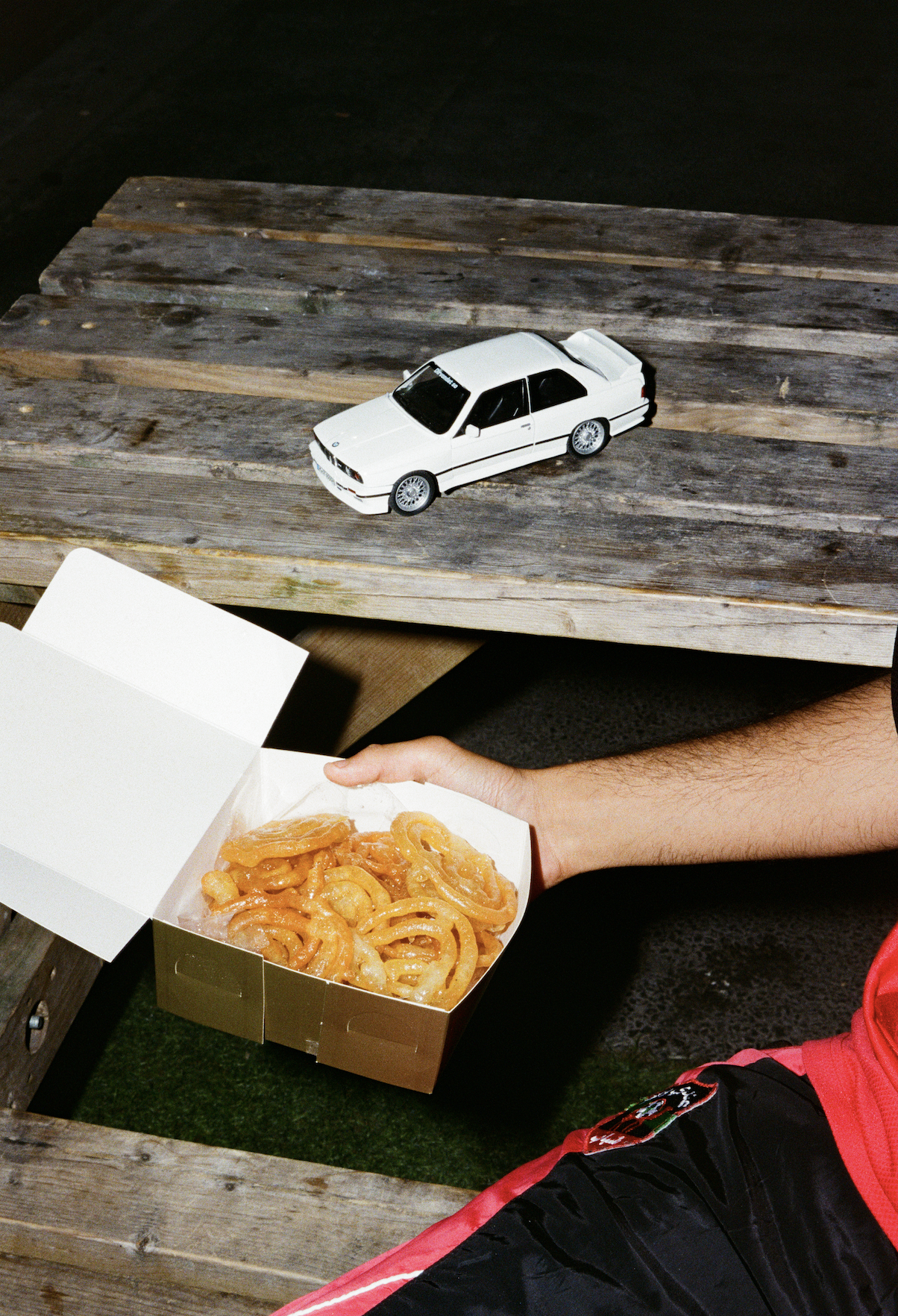
Image: Alina Akbar (@lean0161)
“We were trying to work out what’s our version of that,” he says. “The Pakistani restaurant just made sense.”
It was a place they both knew, but it was also a space that could be transformed. A community third space. A place where people pass through, where the ordinary could become cinematic.
“And also, you can make it beautiful,” Sufiyaan says.
The same instinct runs through Wimmy Road Boyz. Wilmslow Road is recognisable to anyone who has spent time there, but in the novel it becomes something more heightened. Familiar, but slightly surreal. Mythical, even.
“When you’re there, if you’ve never visited and you try to explain to someone, it’s like, ‘What are you on about?’”, he says.
That strange, frenetic energy became part of the book’s world. Sufiyaan could take real places and fictionalise them, exaggerate them, and push them slightly further.
“The Curry Mile feels like someone’s made it up,” he says. “So I can just take liberties.”
We see a version of Wilmslow Road that feels both completely recognisable and entirely new. A place where a homeless man can deliver a surreal monologue, a shisha bar scene can feel like it has been directed by David Lynch, and a night out can slowly become something much more emotionally dangerous.
It is also a place where masculinity begins to unravel.
“On the surface it’s fun, and meanwhile below the surface, everyone’s screaming for help, but they’re just not able to say it.”
Both Magid / Zafar and Wimmy Road Boyz are interested in young South Asian men and the different forms of armour they build around themselves. In Magid / Zafar, the so-called “bad boy” persona begins to crack. In Wimmy Road Boyz, a group of men spend an entire night surrounded by the weight of what they are unable to say to each other.
The original idea for the novel came from Sufiyaan’s own experience of going on a night out and feeling that he couldn't tell the men around him what he was going through.
“I was like, ‘Man, I feel like I can’t tell these guys about it.’ And just the idea of, what if they were going through stuff and they couldn’t say it to me?”
That became the foundation of the novel.
“On the surface it’s fun, and meanwhile below the surface, everyone’s screaming for help, but they’re just not able to say it.”
The characters are constantly shedding layers. Rage, grief and vulnerability eventually force their way through the bravado. But the novel never treats their pain as the only interesting thing about them. That was important to Sufiyaan.
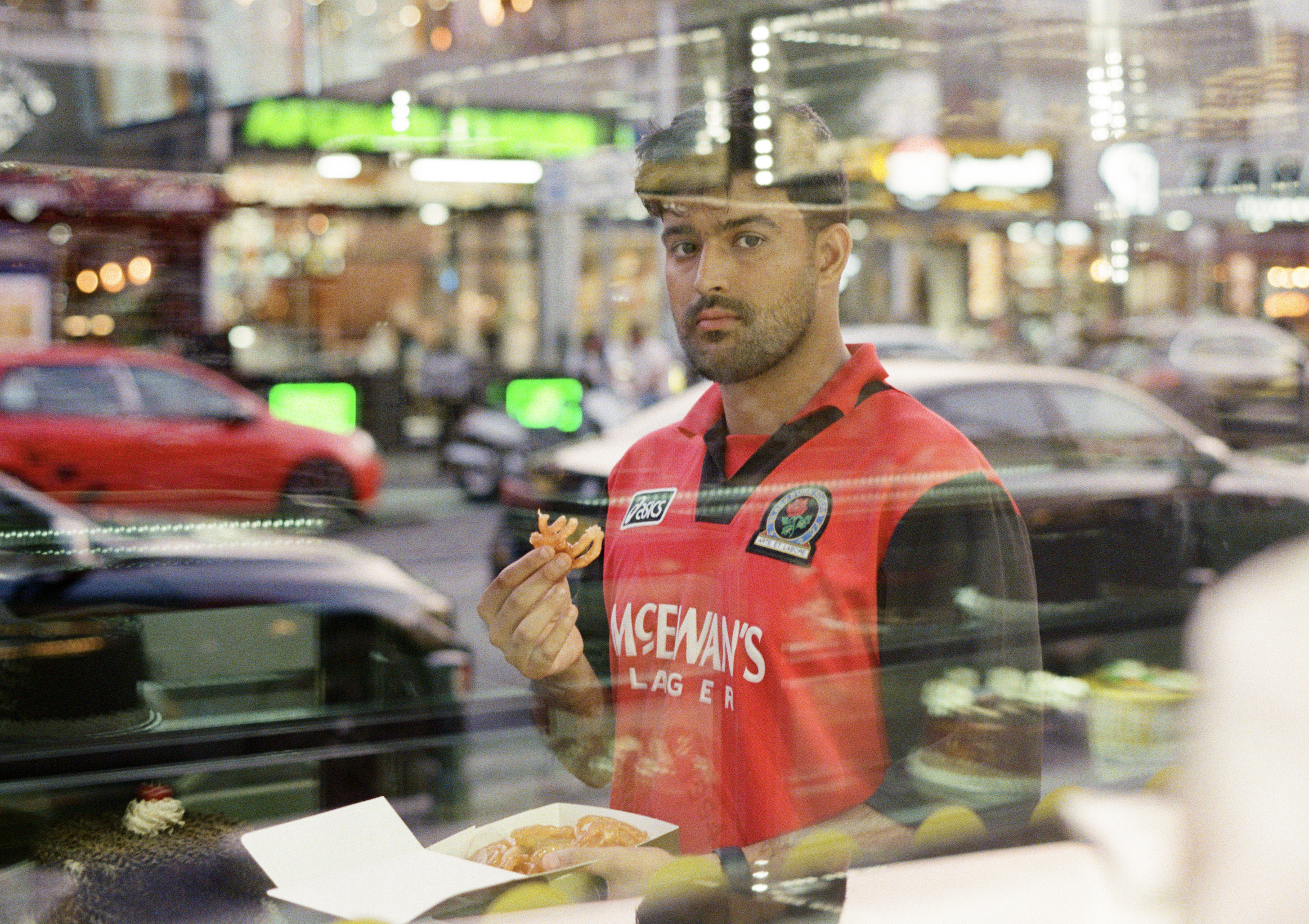
Image: Alina Akbar (@lean0161)
Life, he says, is funny and sad and political and ordinary, all at the same time. He describes the experience of scrolling through Instagram: someone has got married, someone has bought a new car, there is a genocide, someone else is clearly struggling, and then another person posts something completely ridiculous.
“You just get a whole of life in five-second bursts,” he says. “And it just feels like that’s how people are, so I was trying to make the book resemble that.”
That is why Wimmy Road Boyz can move from something genuinely funny to something devastating without feeling as though it is forcing the reader to take a particular emotional position. There are hazy moments in old haunts. There are drugs, arguments and absurd conversations. And underneath all of it, something is coming apart.
“There are funny ways of subverting narratives, but also truthful ways. I’m just really trying to write from honesty.”
The characters themselves were shaped by parts of Sufiyaan’s life; people he had grown up around, and aspects of imagination, but also from a recognisable truth that allows itself to become more strange.
“I don’t know anyone who went to Cambridge and then came back and was like, ‘Ah, I need to reconnect to culture by selling drugs,’” he says. “But there’s something about it that’s funny, and kind of feels true.”
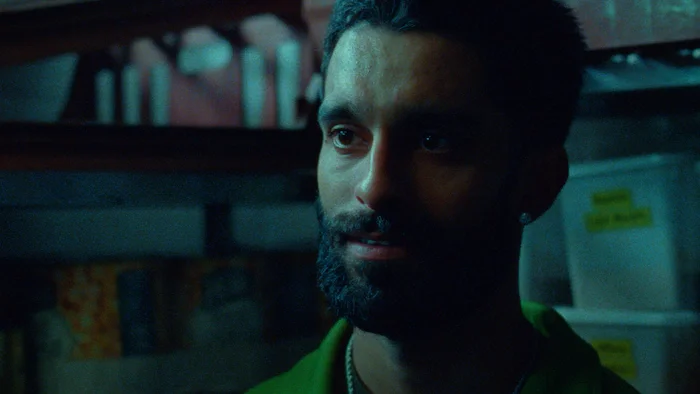
MAGID / ZAFAR: Luís Hindman (Director), & Sufiyaan Salam (Writer). 2025
The same instinct is present in the novel’s treatment of queerness and heterosexuality. Both Magid / Zafar and Wimmy Road Boyz contain characters navigating sexuality, desire and the expectations placed on them, but neither work is interested in making queerness a single, devastating secret around which the entire story revolves.
Sufiyaan is instead particularly interested in what is not explicitly said. No one directly tells a character that he cannot be gay. There is no singular villainous figure representing an entire community. Instead, there is fear and the inability to communicate.
“He’s scared of this thing he might be, and he doesn’t know how to deal with it,” Sufiyaan says. “And that’s not an original Muslim-specific thing.”
This is where his writing resists the expectation that South Asian stories must always explain the source of their characters’ oppression.
“I didn’t want to do tired tropes,” he says. “There are funny ways of subverting narratives, but also truthful ways. I’m just really trying to write from honesty.”
Sufiyaan is aware that there is a responsibility that comes with writing from a community that remains underrepresented. But he is also wary of the idea that his characters should have to carry the weight of representation at all times.
“There’s no such thing as a white book,” he says. “Because there’s just loads of them. Even if I decided I don't want to have the burden of having to represent us, that's going to be thrust upon you anyway.”
And when it comes to representation, perhaps his biggest ambition is also the simplest.
Image: Alina Akbar (@lean0161)
“I think the characters would still be worth watching and interesting,” he says, imagining Magid / Zafar with different characters, or Wimmy Road Boyz as a story about three white men on a night out. “Their heritage influences plot and story and character, but that’s only one of many things.”
They are men. They are British. They are also South Asian. All of these things matter. None of them is the only thing that matters.
For Sufiyaan, that is the kind of writing he wants to make.
He points to The Great Gatsby: a novel that is not usually described as being “about whiteness”. Its characters are allowed to simply be human.
“Wimmy Road Boyz should feel as relatable as Gatsby,” he says. “How many of them do we know?”
It is a question that sits at the heart of his work.
“I always want to do something I feel like I can’t pull off.”
His influences are wide-ranging. Salman Rushdie was an important influence. He also cites Hanif Kureishi, whose work, he says, is unafraid of cultural influence while still writing about people as people. Jamil Jan Kochai’s The Haunting of Hajji Hotak was another important discovery: a collection of stories about the legacy of the war in Afghanistan that can be brutal, political and genuinely funny.
“I’d never seen that,” he says. “You can make it fun, and you can be super political and almost uncompromised with the vision.”
That balance feels central to Wimmy Road Boyz. The novel is not trying to make the reader choose between the political and the personal, or between grief and comedy.
Image: Alina Akbar (@lean0161)
Sufiyaan also has no interest in staying in one place creatively.
He is currently working on screen and television projects, and is interested in stories that feel increasingly different from one another. He talks about writers who can move between genres and subjects, and about wanting to attempt things that feel slightly beyond his current abilities.
“I always want to do something I feel like I can’t pull off,” he says. “What’s the next mountain to climb?”
That ambition is also tied to the way he thinks about entering creative industries that have historically not always made space for people like him.
Winning the Merky Books New Writers’ Prize changed a lot, but it also came with the need to keep going. There is a high, and then there is the reality of getting back to work.
For anyone entering publishing, film or any other creative industry, Sufiyaan's advice is direct.
“Don’t see it as a charity where someone is helping you,” he says. “You actually have value to these institutions. They need you.”
He admits that imposter syndrome still exists, but tries to challenge it by asking himself a simple question: if he were a wealthy white man whose family had been in the industry for generations, how would he behave?
“Then just pretend to feel fine,” he says.
It is perhaps the most Sufiyaan Salam answer possible: funny, but also completely serious.
Because underneath Wimmy Road Boyz is a belief in the value of making things. Of writing characters who are not perfect representatives of anything, and allowing South Asian men to be funny, confused, horny, frightened, complicated and sometimes completely ridiculous.
When I ask what he ultimately wanted from Wimmy Road Boyz, his answer is simple.
“I want people to read the thing.”
Finally, he adds: “More people should read because it’s cool.”
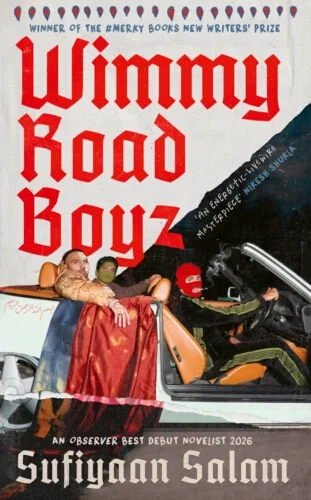
Wimmy Road Boyz, cover design by Zahraa Naseer